


Getting a handle on personal finances isn't just smart, it's the foundation of peace of mind. But as you will see in this article there are many pathways to becoming a millionaire and not everyone has the same solution, if that was the case there would be no market to speak of.
At the individual level, you're always playing the same game: money comes in, money goes out. Think about it like this: there is debt and equity, as an individual you collect income and you spend it either on equities (savings, investments, or goods), or debt (personal, like a credit card, or investment, like a mortgage). So, then what can you do? Limit your taxes (increase equity in), maximize your savings (grow your held equity/debt), and reduce your debt (pay down dues). This will speak on some topics and acronyms that will pique any readers’ interest, please refer to the headings.
The Rule of 72
This is the eye-catching part of long-term investment, simple to apply yet hard to fully understand, a powerful quiet tool fueling millionaires left and right. While being a slightly ugly formula, it is actually very simple in nature, assuming you can model your average percentage return (r).
The rule works like this: divide 72 by your average annual return, and you get the approximate number of years it takes for your money to double. Let’s say your entire portfolio was S&P500 (Standard and Poor’s), something that earns 6-7% year-over-year accounting for inflation. You’re outpacing inflation and assuming the low average 72 / 6 = 12. This means that on the lower side of the average, your money will double in twelve years. Now compound growth is fundamentally hard for the brain to understand but think hard about that, here is an example.
For some Americans, a savings account around $250,000 is very possible by their mid-thirties. Meet Fred. Fred is a 37-year-old software developer, through savvy investing and constant saving, Fred has amassed a brokerage account with $250k in it. He only owns exposure to the S&P500 in this account, he has no intention of selling, and he earns 7% per year on average. Fred will be a millionaire when he is at full retirement age (67), with no additional investment or effort and accounting for inflation. When Fred was 42, Fred meets Velma. Velma is the heir and only daughter of a senior executive, married a year later and Fred has no reason to sell even in retirement. If Fred can stay healthy until 97, he will likely have four million dollars to pass to his descendants.
Now while sixty-nine is more accurate, seventy-two accounts for an investor not holding their positions through market turbulence, regardless of common rationality. Fred is unlike most investors so this math doesn’t exactly account for him. Before breaking down some different math quantifying investor rationality, let’s mention that in Fred’s case there is a good possibility he could have had eight million dollars to pass to his descendants.
Prospect Theory
Prospect theory, a cornerstone of behavioral economics, explains why people react far more strongly to losses than to equivalent gains. It's also exactly why the difference between 72 and 69 matters: rational investors hold. Irrational ones don't.
When you plot prospect theory on a graph, the result is striking. Value drops sharply on the loss side, far faster than it climbs on the gain side. Losing $500 doesn't just feel like the inverse of gaining $500. It feels significantly worse— and that asymmetry drives a lot of poor financial decisions.
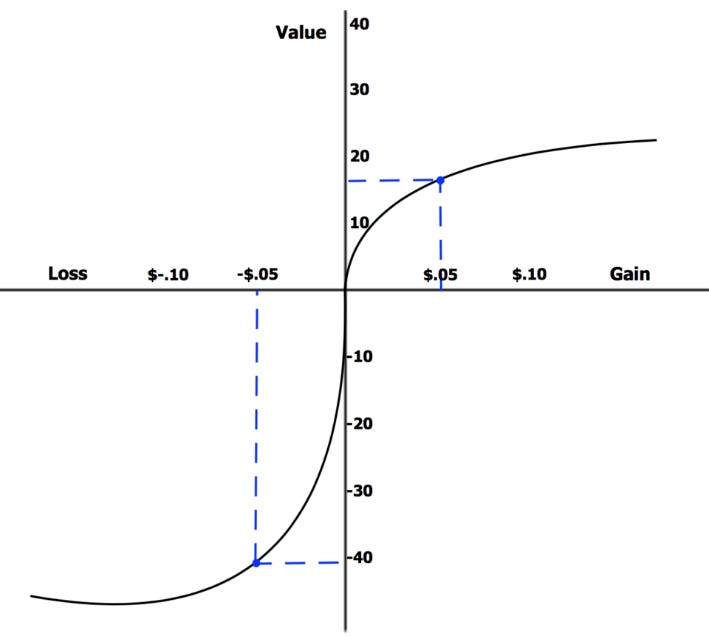
Enter Shanice and Trevor. Shanice and Trevor both hold brokerage accounts with their financial advisors. Trevor looks towards aggressive yet risky growth, while Shanice wants low risk at the cost of slow growth. They both contribute a million dollars, and they wait.
Two years later, Trevor saw huge growth; his account is now worth two million dollars. On the contrary, Shanice saw a steady yet wonderful increase to a million and a half dollars. Then the market corrects; but their advisor has kept both accounts under control. Trevor now has a million and a half, along with Shanice (her low-risk account avoided the market effect), yet something odd remains. Shanice is quite happy, her low-risk account worked! On the contrary, Trevor is peeved he saw 500 grand disappear! They both have had the same results, but the emotional discrepancy is clear. The actual value is the same but following prospect theory, the perceived value is wildly different.
The takeaway is straightforward: be a rational investor. Hold your indexed positions. Trust the process. The math has proven it works, time and time again. You just have to give it time.
Typed Loudly, By Jack Young
https://web.mit.edu/curhan/www/docs/Articles/15341_Readings/Behavioral_Decision_Theory/Kahneman_Tversky_1979_Prospect_theory.pdf – Great breakdown of the full equation
https://www.drs.wa.gov/episode-67-why-the-rule-of-72-feels-like-magic-but-isnt/ - Makes compound growth easier to understand
https://en.wikipedia.org/wiki/Rule_of_72 – Not very comprehensive, but provided the math
w